below, it means that class was videoed and you can get a link by e-mailing me.
Note that if you know ahead of time that you will miss a class, you should
tell me and I will be sure to video that day for you.
Here is a link back to the course syllabus/policy page.
This schedule is will be changing very frequently, please check it at least every class day, and before starting work on any assignment (in case the content of the assignment has changed).
If you see the symbol
below, it means that class was videoed and you can get a link by e-mailing me.
Note that if you know ahead of time that you will miss a class, you should
tell me and I will be sure to video that day for you.
A set together with a metric is called a metric space.
A set $C$ is called closed if $C^c$ is open.
A set together with a metric is called a topological space.
[If $X\cap Y\neq\emptyset$, first make new copies of $X$ and
$Y$ which are disjoint, then do the above.]
A T2-space is also called Hausdorff.
[There are also definitions of T3 and T4, but we
will not use them in this class.]
Extra credit: For which sets $X$ is $X$ with the finite
complement topology Hausdorff and for which not Hausdorff? Prove
it!
Definition: Given topological spaces
$(X,\Oo_X)$ and $(Y,\Oo_Y)$, where $X\cap Y=\emptyset$, we define
the disjoint union $X\sqcup Y$ to be the topological space
whose points are $X\cup Y$ and whose open sets are those sets
$O\subset X\cup Y$ satisfying $O\cap X\in\Oo_X$ and
$O\cap Y\in\Oo_Y$ — i.e., the parts of $O$ in $X$
and $Y$ are open in $X$ and $Y$, respectively.
Here are some details about how to "make new copies of $X$ and $Y$
which are disjoint":
[If $X\cap Y\neq\emptyset$, first make new copies of $X$ and
$Y$ which are disjoint, then do the above.]
Note that if we had such $A$ and $B$, it would follow that
$A=B^c$ and $A=B^c$, meaning that $A$ and $B$ would also be
closed. Therefore, this definition is equivalent to saying
that $X$ has no clopen subsets other than $\emptyset$ and $X$
itself.
Note also that if we had such $A$ and $B$, it would follow
that $X=A\sqcup B$. Therefore, this definition is also equivalent
to saying that $X$ cannot be written as a non-trivial disjoint
union.
[Of these, the last is the most difficult to prove carefully and
completely.]
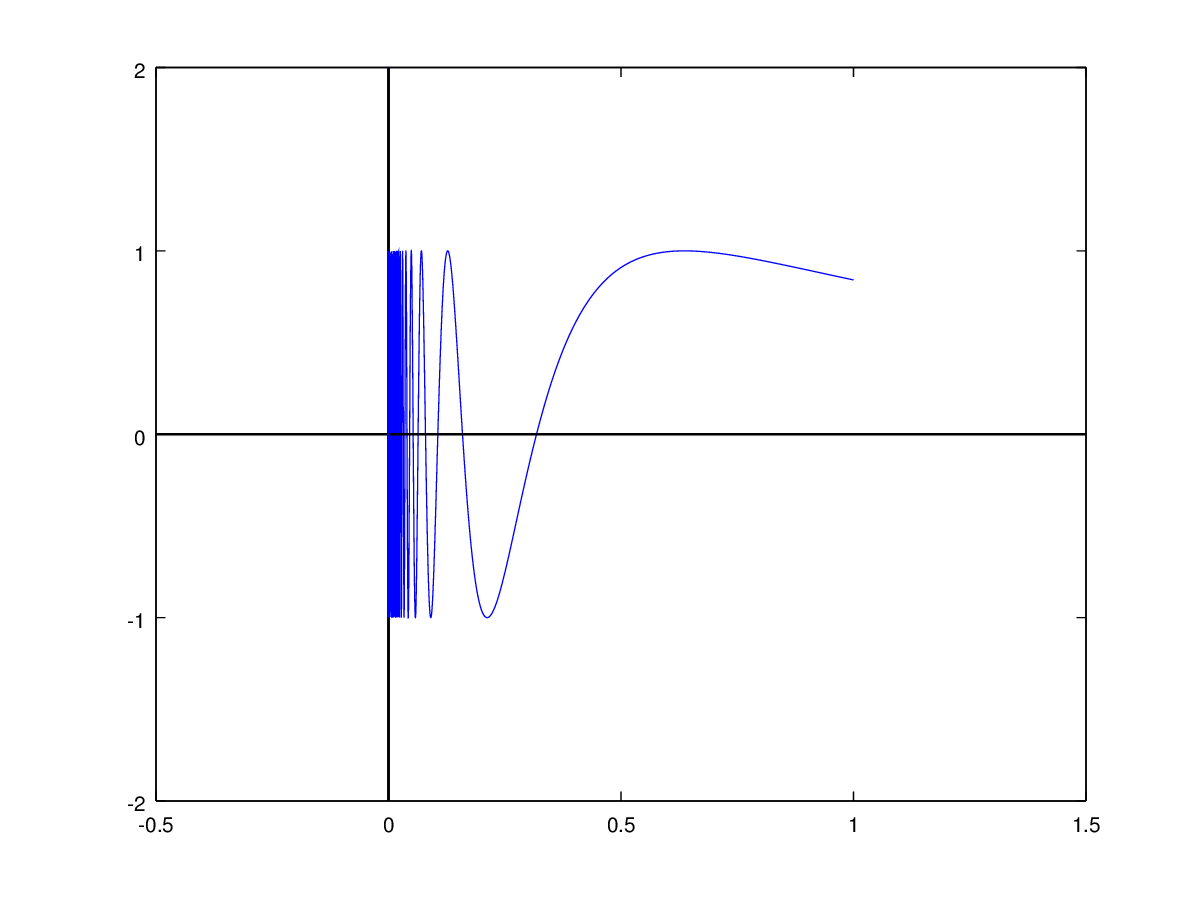
A special case of this is the circle, another name for
$S^1$.
Proof: This is a nice proof, which you should know. It
involves the facts that the connected sets in $\RR$ are the
intervals and that the continuous image of a connected set is
connected (both of which you should also be able to prove).
Space
# cut points
# non-cut points
$(a,b)$
$\infty$
0
$[a,b]$
$\infty$
2
$(a,b]$ or $[a,b)$
$\infty$
1
$\left([-1,1]\times\{0\}\right)\cup\left(\{0\}\times[-1,1]\right)\subset\RR^2$
$\infty$
4
$\RR$
$\infty$
0
$\RR\sqcup\RR$
0
$\infty$
$\RR^n$ for $n≥2$
0
$\infty$
$S^1$
0
$\infty$
Proof: This is a nice proof that uses the following
property of the real numbers:
Recall that for any $n\in\NN$, a set $S\subset\RR^n$ is
called bounded if $\exists r\in\RR$ such that $S\subset
B(\vec{0},r)$. Also, given a set $S\subset\RR$, a least upper
bound for $S$ is a number $L\in\RR$ such that
Equivalently, the open sets of $X/\sim$ are exactly the sets
of equivalence classes whose unions are open sets in $X$.
On $R$ use the open cover consisting of all the sets $R\cap B$,
where $B$ is any ball of radius $1/2^j$ for some $j\in\NN$ and
centered at some point $(x,y)\in R$.
Now explain carefully how Hatcher's proof applies in this case.
That is, for each variable he uses in his proof ($U_{xy}$,
$V_{xy}$, $U_x$, $y_1, \dots, y_n$, etc.), tell what it is
in this example and how it does what Hatcher says it does.
Conversely, given $X$, $\sim$, and $Y$, if
$g:X/\sim\to Y$ is continuous, then the function
$g\circ q:X\to Y$, where $q:X\to X/\sim$ is the quotient map,
is continuous and obeys $\overline{g\circ q}=g$.
$$\begin{matrix}
X&&\\
\downarrow&\searrow&\\
X/\sim&\rightarrow& Y\end{matrix}$$
Note we usually write the group operation multiplicatively, but
it could equally well be written as $g+h$.
When $G$ is a topological group and $X$ a topological space,
we require the action map $G\times X\to X$ to be continuous.
(There are many images of this family of circle on the Internet,
search for "Hopf fibration". E.g., this one and this also are quite
good.)
Now fill each such torus with a family of circles which go
once around diagonally
The collection of all circles on all tori is the rest of the
circles we use to fill $S^3$.
Define an equivalence relation $\sim$ on $S^3$ whose equivalence
classes are the above circles. Notice that every single circle
passes through the closed unit disk $D$ in the $x$-$y$ plane at
exactly one point, except the edge, which is one entire circle.
Therefore modding $D$ out by the induced equivalence relation
$\sim$ on $D$ leaves everything alone except that it crushes the
edge of $D$ to a single point, yielding $S^2$.
We can map $S^1$ 1-1 into $S^3$ as any of the above circles. Then
$S^3$ has an onto map — the quotient map — to
$S^3/\sim\cong D/\sim\cong S^2$. This diagram
$$S^1 \hookrightarrow S^3\twoheadrightarrow S^2$$
is called the Hopf fibration.
then we say $H$ is a subgroup of $G$.
Since $(0,1)$ is homeomorphic to all of $\RR$, there should be
two corresponding compactifications of $\RR$: the one-point
compactification $\overline{\RR}^{{}_1}$ (which we did discuss in
class and talk about how it is homeomorphic to $S^1$ — think
stereographic projection!), and a two-point compactification which
will will denote (in this problem only, it is not a standard
notation) $\overline{\RR}^{{}_2}$.
Prove your answer, and give an example of each type of function,
and an example where the extension does not exist.
Proof: Use a diagram like
this one to
prove associativity, and similar ones to handle inverses,
etc.
Proof: Look at
this picture.
Conclusion: $\pi_1((S^1\vee S^1,\overline{1})$ is isomorphic
to the free group $F(R,L)$.
(b) Give three explanations that your map is not a
homeomorphism: first, show directly that its inverse is not
continuous. Second, use compactness, cut points, or something
else from last week or before. Third, use fundamental groups.
Our definition of the $n$-sphere even works for $n=0$: describe
$S^0$.
Now, pick any point of $S^0$ as a basepoint $s_0$ to make it a
pointed topological space, and let $(X,x_0)$ be any other pointed
topological space. Describe $\pi_0(X,x_0)=\left[S^0,X\right]$.
(a) Explain why this gives the same space as the definition we've
used before for $\RR\PP^2$.
(b) Find a covering space for $\RR\PP^2$. Use it to compute
$\pi_1(\RR\PP^2,x_0)$ where $x_0$ is the point of $\RR\PP^2$
consisting of the north and south poles of $S^2$.
(c) Let $\alpha$ be the semicircle on $S^2$ going from the north
pole to the south pole. What is the class
$[p\circ\alpha]\in\pi_1(\RR\PP^2,x_0)$? What happens when we
square that element in $\pi_1(\RR\PP^2,x_0)$?
Please make an effort to ensure your paper is clear and easily
readable: typing (or typesetting with LaTeX) is encouraged
but not required. Do make a draft and then a final version, that
helps enormously in the quality of written work.